Researchprogramme Sustainable production
Sustainable production
In the world of polymer technology, sustainable production is an important topic. It is one of the four core themes of the Professorship for Polymer Engineering and lies at the heart of our mission. Our goal is clear: to optimise existing polymer processing methods, such as extrusion and injection moulding, for a sustainable future.
In our pursuit of sustainability in polymer technology, we have strong industry partners, including Wavin and CF Kunststof Profielen. Together, we are committed to sustainable production processes that benefit both us and the planet.
Our efforts are strengthened by the involvement of students from Windesheim University of Applied Sciences. This collaboration also narrows the gap between education and industry.
All of this is made possible in part by the support of the TechForFuture and GreenPAC Centres of Expertise. Together, we are building a sustainable future in which we not only improve polymer technology but also create a positive impact on our environment and on generations to come.
The Sustainable Production research programme is focusing on optimising today's polymer-processing methods for the future by modifying the machinery. We determine how these modifications should be made on the basis of simulations, after which they are validated in practice. We do this by building prototypes or by using intelligent measurement systems. Below you will find all the information about our research in the field of Sustainable Production.
-
-
Faciliteiten
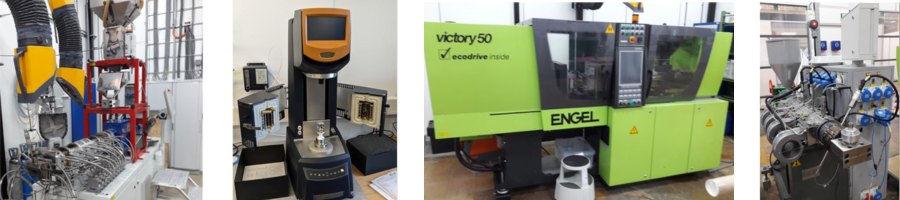
The Sustainable Production research programme has access to equipment including an Engel Victory 50-ton injection-moulding machine, a CONEXTRU single-screw extruder, a KraussMaffei twin-screw extruder and an HR-10 rheometer from TA Instruments. This equipment makes it possible to validate the research group's simulations and analytical solutions in practice.
-
-
-
Master Polymer Engineering
The Master Polymer Engineering programme includes a rheology module. This module provides valuable theoretical knowledge about polymer behaviour and the full range of aspects involved in extrusion and injection moulding. We cover everything from material deformation to polymer processing, with attention to matters such as mould design, clamping force, injection time, cooling time and mould construction.
What can you expect from this module?
You will learn how to define crucial functional requirements for a design so that you can select the right production methods to meet those requirements. This is reinforced by numerous practical examples, and you will also have the opportunity to become familiar with simulation techniques.
The module is divided into four core components::
- Rheology and mechanics of polymers
- Polymer processing
- Polymer testing
- Simulation techniques
This is a structured journey through the field of polymers and production processes, with an emphasis on acquiring valuable, applicable knowledge.
-
Minor projects for Production Engineer and Thermodynamical Engineer
Within Windesheim's Production Engineer and Thermodynamical Engineer minors, students carry out minor projects within the Sustainable Production research programme. This gives students the opportunity to become involved in the research group's work over a short period. Minor projects may involve simulation, practical experiments, process or product optimisation, and much more.
-
Graduation and internship assignments
There is plenty of scope within the Sustainable Production programme line for internship and graduation assignments. Assignments can often be tailored so that they align seamlessly with Windesheim's expectations and requirements. They may have a strongly practical or strongly theoretical focus, or anything in between.
With experts close at hand and the facilities needed to conduct high-quality research, this is the ideal place to demonstrate and further develop your research skills.
-
-
-
Mixing in single screw extruders deel I, II en III
This TechForFuture(opent in nieuw tabblad)-project developed a method for optimising mixing elements on the basis of numerical simulations (Computational Fluid Dynamics, CFD). A numerical procedure was developed to calculate the flow field in the extruder. By tracking particles in this field, data are collected to determine distributive mixing.
Based on these data, metrics such as the residence-time distribution and Shannon entropy were used to quantify mixing. This makes it possible to compare numerical values with experimental values so that the developed procedure can be validated through laboratory-scale experiments using different mixing elements in a single-screw extruder.
Ultimately, this numerical procedure can be used to analyse, optimise and assess the performance of different mixing elements. The work was carried out in close collaboration with Wavin T&I(opent in nieuw tabblad).
View the research results below:
Deel I Experimental Validation(opent in nieuw tabblad)
-
Die Swell (graduation project by researcher Tijmen Mateboer)
The extrusion of uncured rubber is an essential process in the tyre industry. When rubber is extruded, the material expands, a phenomenon known as die swell. The extent of die swell depends on various process parameters, including the shape of the die, production speed, rubber composition and the rubber's elastic behaviour. Designing extrusion dies is costly and time-consuming because of die swell. Numerical simulations of the extrusion process can assist with die design.
Traditional numerical methods based on fluid mechanics can be used to simulate flow patterns and pressure build-up (flow resistance) within the die. However, die swell introduces specific complexities because of the material's viscoelastic nature and the intricate boundary conditions.
This research proposes a procedure to support the design of extrusion dies for industrial rubber extrusion by combining rheological measurements with numerical simulations. The simulated die swell is verified against experimental results. This approach can help optimise extrusion-die design in the tyre industry, potentially leading to improved production processes and lower costs.
-
KOENST (saving costs in the polymer industry)
This project, called KOENST and funded by the Dutch government through the Innovation Alliance Foundation (SIA) under the RAAK International programme, focuses on developing energy-efficient polymer production technologies using renewable energy sources.
Collaboration with the University of Duisburg led to three main areas of focus: optimising the energy use of production processes, using alternative and sustainable energy sources, and reusing and storing residual heat.
The project results are presented in two documents. Part one focuses on the use of alternative and sustainable energy sources, while part two addresses the other two areas: optimising the energy use of production processes and reusing and storing residual heat. Both reports are listed below.
KOENST Part I (opent in nieuw tabblad)
KOENST Part II(opent in nieuw tabblad)
The name KOENST is derived from the German and Dutch words for 'art' and symbolises how the sustainability of energy is valued depending on one's perspective, in much the same way as art is appreciated.
-
Texture Injection Moulding (graduation project of Cristian Hummel)
This research, conducted in collaboration with Philips(opent in nieuw tabblad) Consumer Lifestyle B.V., aims to find an alternative to two-component injection moulding for the design of shaver grips. The goal is to achieve the desired combination of rigidity and softness using only one polymer, specifically a glass-fibre-reinforced Softell polymer.
The study focuses on optimising softness by reducing the number of fibres at the product surface through various surface textures. Injection-moulding experiments and Moldex3D simulations are used to investigate the relationship between fibre behaviour and product softness.
The results show that surface textures with fewer fibres at the surface produce greater softness, with lower friction as the main factor. In addition, coarser surface textures tend to be softer than finer patterns because friction is reduced when fewer fibres are perpendicular to the surface.
In short, surface textures and their dimensions affect the behaviour of glass fibres and influence a product's softness.
-
-
-
Partners
Throughout our projects, we collaborated with many different organisations from industry. An overview is provided below.
-
-
-
Logo Duurzaam Produceren
 Our logo consists of a blue circle, two cogwheels and a small plant, visually conveying the concept of sustainable production in an appealing way.
The blue circle represents the planet and the responsibility we bear to protect and preserve our natural resources. The colour blue symbolises integrity and reliability, emphasising that sustainable production is a dependable and ethical approach.
The two cogwheels symbolise industrial production and technology. They turn in harmony with one another, highlighting the collaboration needed for sustainable production.
The small plant in the logo represents growth, life and renewability. It emphasises that sustainable production is not only about conservation, but also about enabling developmental growth without harming our planet.
Taken together, the logo symbolises sustainable production as a responsible, efficient and evolving approach to preserving and improving the balance between industry and the environment.
-
Research Programme Manager Buist
Jakob Buist graduated and obtained his doctorate (1991) from the University of Twente's Faculty of Mechanical Engineering in the field of heat and fluid dynamics. He subsequently worked mainly in equipment construction for energy technology, from extraction through to use. He has been affiliated with Windesheim University of Applied Sciences in Zwolle since 2010 and is responsible for the Sustainable Production research programme within the Professorship for Polymer Engineering.
Within this programme, we investigate processing techniques such as injection moulding and extrusion through flow simulations and experiments. Research topics include extrudate swell (die swell), mixing with a single-screw extruder, ultrasonically assisted extrusion, and the surface textures of injection-moulded products.
In addition to his research within Sustainable Production, Jakob is responsible for the rheology and polymer-processing courses in the Master Polymer Engineering programme at Windesheim and NHL Stenden universities of applied sciences. Connecting research and education is an important motivation for him when identifying suitable projects, with their added value for industry sought and verified in consultation with partners.
Meet our researchers
Dr. Margie Topp, lector
Margie Topp is lector Kunststoftechnologie bij Windesheim en gespecialiseerd in onderzoek op het gebied van composietmaterialen en polymeertechnologie.
Tijmen Mateboer, onderzoeker
Tijmen Mateboer heeft een brede wetenschappelijke interesse. Hij is specialist op het gebied van modellering en simulatie én is actief binnen de programmalijn duurzaam produceren.
LinkedIn (opent in nieuw tabblad)Jordin van 't Veld, onderzoeker
Onderzoeker Jordin heeft een achtergrond in de Werktuigbouwkunde. Met simulatietechnieken wil hij de theorie en de praktijk te verbinden. Dit doet hij binnen de programmalijn 'Duurzaam Produceren'
LinkedIn (opent in nieuw tabblad)Would you like to know more?
Would you like to work with us on a research project? Contact us and we will discuss the possibilities.
Neem contact met ons op
-
Bereikbaarheid
Op werkdagen tussen 09.00 en 17.00 uur